Dungeons are dark, abandoned holes filled with horrors, lost souls, and treasures. They were once someone’s home or lair that fell to ruin a long time ago. Nowadays, people explore the labyrinths and face scary beasts as a test of strength. Also, because, treasure!
Dungeon Generator
There will be times when you need to create a map for your players to explore. Making these maps can be done quickly and easily using Essence and Energy’s dungeon generator.
To decide the next area of your dungeon, you can either choose it yourself or roll for a random outcome with the generator.
Step One: Location, Location, Location
The first step to building your dungeon is to figure out where in the world it is located. The location table lists a variety of places it could be located. If you are unsure, roll based on the table.
| d20 | Location |
|---|---|
| 1 | Barren Lands |
| 2 | City (underground or above ground) |
| 3 | Cliff |
| 4 | Dead Forest |
| 5 | Dense forest |
| 6 | Hilly Plains |
| 7 | Jungle |
| 8 | Mountain Peak |
| 9 | Mountains |
| 10 | Off a Mountain Path |
| 11 | Open Plain |
| 12 | Rocky Hills |
| 13 | Rocky Plain/Valley |
| 14 | Rolling Hills |
| 15 | Sparse Forest |
| 16 | Swamp |
| 17 | Town (underground or above ground) |
| 18 | Tundra |
| 19 | Underground |
| 20 | Underwater |
Barren Lands
A wasteland with darkened infertile soil, open space, and little to no vegetation or animal life.
City
The settlement is flourishing with a lively and populous community. It’s busy, crowded, and swarming with life. There are tall buildings to marvel at and many shops to spend your hard-earned coin.
Cliff
A sheer drop-off, particularly along the coast.
Forest
A large area dominated by trees. There are different forest. Barren forests have sparse tree coverage and a small amount of wildlife. Dense forests are thick, warm, and cramped with heavy tree coverage. Dead Forests hold the corpses of the once vibrant trees. Now all that remains are gray, dark husks of any life.
Hills
Large landforms that extend above the surrounding terrain. There are many forms of hills. Hilly plains where the land is flat except for the hills. Rocky hills that surround the base of mountains. Rolling hills which, because of their formation, have an up and down motion to them when traversing them.
Jungle
The atmosphere is humid and dense with dangerous creatures lurking. Jungles are extremely dense forests and tangled vegetation, usually in the tropics.
Mountain
Massive landforms that can touch the clouds. Mountains are the rocky, sharp behemoth of land formations. They can have volcanoes living inside them or massive cave systems intertwining beneath the surface.
Plains
A flat, sweeping landmass that rarely changes in elevation. They occur in lowlands along the bottoms of valleys or on the doorsteps of mountains. Plains in valleys are enclosed on two sides by mountains or hills.
Swamp
A low-lying region of land where water accumulates and is not cultivated. Also known as bog or marsh.
Town
The smaller version of a city with less populous shops, authority, and general glamour.
Tundra
The frozen lands full of ice and snow. There are multiple other types of locations found in the tundra, from mountains, to hill, to snow blown plains. The one thing that never changes about this location is that it’s always cold.
Underground
The deep dark under dwelling where the mysterious unknown creatures thrive. The underground is home to the subterranean creatures. It is a cold and damp place but also can have thriving metropolis and bustling towns.
Underwater
In the depths of the ocean, where air is sparse and massive creatures swim. Underwater locations can be caves, aquatic cities or towns, or shipwrecks.
Step Two: Entrance
The second step is to choose a type of feature from the list below that you want the entrance of your dungeon to be. If you’re unsure, roll based on the table.
| d12 | Entrance Type |
|---|---|
| 1 | Abandoned building |
| 2 | Basement |
| 3 | Closed but unlocked (or locked) portcullis |
| 4 | Deep Cave |
| 5 | Hidden door with hidden lever |
| 6 | Hole in the wall (or floor) |
| 7 | Magic portal |
| 8 | Open but broken portcullis |
| 9 | Open pit |
| 10 | Reinforced door (metal; stone; etc.) |
| 11 | Shallow Cave |
| 12 | Trap door |
Abandoned Building
This could be a building in a populated city/town, or a random location in the middle of nowhere. The building is decrepit but doesn’t have to be. It would be freshly abandoned or maybe under a curse where it always appears pristine and full of supplies.
Basement
A cellar or basement of a building that could be abandoned or occupied. The basement could be the dungeon, or it could be the entrance to it. It could also be hidden to the owners of the building, or perhaps they know all about it and build the dungeon themselves.
Portcullis
A large metal gate typically opened through pulleys, chains (or large ropes) in a vertical manner.
Cave
Large, small, or expansive and underground. Caves can be of all different forms and shapes. The cave could just be the entrance leading into a more detailed maze of passages, or it could be the dungeon itself.
Hidden Door
A portal hidden from plain sight. The location of the door could be anywhere from a secret panel on a wall to an object on a bookshelf that turns the fireplace into a staircase.
Hole/Pit
A hole or pit can be found in the ground, wall, cliff face, or even floating in midair. The size of the hole could be large enough for a wagon small only small sized creatures could fit.
Magic Portal
A doorway leading to the unknown. An oval rift in space that sparkles and leads to a secret location. Or, it could be a standard door that, when turning the doorknob, a special way activates the magical portal, instantly teleporting the subject.
Reinforced Door
This door stands out because of its heavy reinforcements. The owner of whatever if behind that door is not afraid of hiding their secret but is making sure no one can get into it.
Trap Door
A wooden or metal, typically locked door in the ground. Trap doors are normally either in a basement or on the first floor leading down into the dungeon. However, they could be on any floor of a building (or outside) where the pathway leading in is hidden in the walls or foundations.
Step Three: Structure Building
Now that you have your entrance, the next step is to have it led somewhere. It could be as simple as being a single large room (or small). It could also lead to a complex maze of passages, traps, monsters, and magical trickery. The choice is yours to be as mischievous as you want.
The way building the rooms, passageways, dead ends, and other structures inside the dungeon is based on different rolls. If you already know the width and lengths or layouts of your dungeon, then this step can be skipped.
Area Size Calculator
When rolling for your dungeon areas, the result of the dice is multiplied by five feet. So, if you are making a passageway you would roll 1d4 for the width and 1d10+1 for the length. Let’s say the 1d4 rolls a three and the 1d10+1 rolled a five. The passageway would be fifteen feet wide and twenty-five feet long (15ft.x25ft. hallway).
If the maximum space is not large enough, increase the dice size to the next increment (1d4 to 1d6).
Abnormally Sized Areas
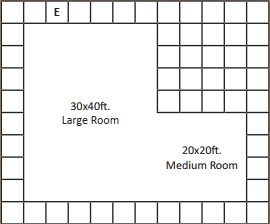
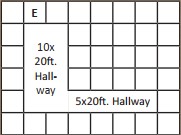
Roll a smaller room after rolling the bigger room to create a room with an abnormal size, such as a smaller area off to the side, and attach it to the larger one. This combines the rooms into a larger altered room. For example, let’s say we make a large room that is 30ft. x40ft. but we want to have it be an L-shaped room. We would roll a medium room and get 20ft.x20ft. which we connect to the right side of the large room at its length’s end. The same can be done with passageways.
Abnormally Sized Room Example
Abnormally Sized Passageway Example
Dungeon Material
Once you have your areas all mapped out, it’s time to fill them with stuff.
| d12 | Door | Health |
|---|---|---|
| 1 | Curtain Cloth | 2 |
| 2 | Curtain Fur | 5 |
| 3 | Curtain Leather | 8 |
| 4 | Door Hinge | *Per hinge |
| 5 | Door Hinge Reinforced | *Per hinge |
| 6 | Metal Basic | 60 |
| 7 | Metal Reinforced | 80 |
| 8 | Stone Basic | 30 |
| 9 | Stone Carved | 40 |
| 10 | Wood Basic | 10 |
| 11 | Wood Reinforced | 25 |
| 12 | Wood Sturdy | 20 |
| d8 | Wall/Floor | Health by Sq. Ft |
|---|---|---|
| 1 | Brick | 40 |
| 2 | Dirt | 5 |
| 3 | Metal Basic | 70 |
| 4 | Metal Reinforced | 80 |
| 5 | Stone Basic | 30 |
| 6 | Stone Reinforced | 40 |
| 7 | Wood Basic | 10 |
| 8 | Wood Reinforced | 20 |
| d8 | PIllar | Health by Sq. Ft |
|---|---|---|
| 1 | Brick | 30 |
| 2 | Metal Basic | 50 |
| 3 | Metal Reinforced | 70 |
| 4 | Stone Basic | 20 |
| 5 | Stone Reinforced | 40 |
| 6 | Wood Basic | 10 |
| 7 | Wood Reinforced | 20 |
| 8 | Clay | 5 |
| d4 | Statue | Health by Sq. Ft |
|---|---|---|
| 1 | Metal | 40 |
| 2 | Stone | 20 |
| 3 | Wood | 10 |
| 4 | Clay | 5 |
| d20 | Furniture | Health by Sq. Ft |
|---|---|---|
| 1 | Metal Bench | 50 |
| 2 | Metal Chair | 40 |
| 3 | Metal Stool | 40 |
| 4 | Metal Table | 50 |
| 5 | Metal Cabinet | 45 |
| 6 | Stone Bench | 25 |
| 7 | Stone Chair | 20 |
| 8 | Stone Table | 25 |
| 9 | Stone Cabinet | 20 |
| 10 | Wood Bench | 15 |
| 11 | Wood Chair | 10 |
| 12 | Wood Stool | 10 |
| 13 | Wood Table | 15 |
| 14 | Wood Cabinet | 10 |
| 15 | Clay Bench | 10 |
| 16 | Clay Chair | 5 |
| 17 | Clay Stool | 5 |
| 18 | Clay Table | 10 |
| 19 | Clay Cabinet | 10 |
| 20 | Reroll | – |
Hinge
The health of a hinge is half of the door’s health plus ten. Curtains don’t have hinges.
Walls & Floors
Inflicting damage to a wall or floor is done in square feet. Directly attacking a wall or floor causes a one-foot section to take damage. The area of effect items damage a certain number of feet of wall or floor covered by the area.
Step Four: Monsters & Traps
Now it’s time to add your monsters and traps. For monsters, it depends on what level the characters are and how challenging of a dungeon you want.
Step Five: Oh Shiny! (Treasure)
The final step is to add the treasure.
 Essence & Energy
You must be logged in to post a comment.